If you have been searching for a Montessori preschool in Chino, CA, chances are you have already realized something:
Choosing a preschool is not as straightforward as it first seems.
Every school promises a nurturing environment. Most websites mention caring teachers, safe classrooms, and kindergarten readiness. After a while, many schools start sounding very similar, which can make the decision feel even more overwhelming.
At the same time, parents naturally have important questions:
What makes Montessori different?
Is Montessori actually better for my child?
What age should preschool start?
How do I know if a school is genuinely good?
The truth is, there is no single preschool that is perfect for every child.
What matters most is finding an environment where your child feels supported, confident, curious, and excited to learn.
This guide is designed to help families better understand Montessori education, what to look for when comparing schools in Chino, and how to make a more confident decision for your child.
Why Many Families in Chino Choose Montessori Education?
Many parents searching for the best Montessori preschool are often looking for more than academics.
During the early years, children are developing important skills that go far beyond learning letters and numbers.
They are learning how to:
- Build confidence
- Communicate with others
- Follow routines
- Solve simple problems
- Become more independent
For many families, Montessori feels like a balanced approach because it supports both learning and child development in a natural way.
Rather than rushing children through academics, Montessori classrooms are designed to help children build confidence, concentration, independence, and a genuine love for learning.
This is one reason why many families in Chino consider Montessori during the preschool years.
According to the American Montessori Society, Montessori education encourages independence, self-discipline, and hands-on learning through child-centered classroom experiences.
What Makes a Montessori Preschool Different?
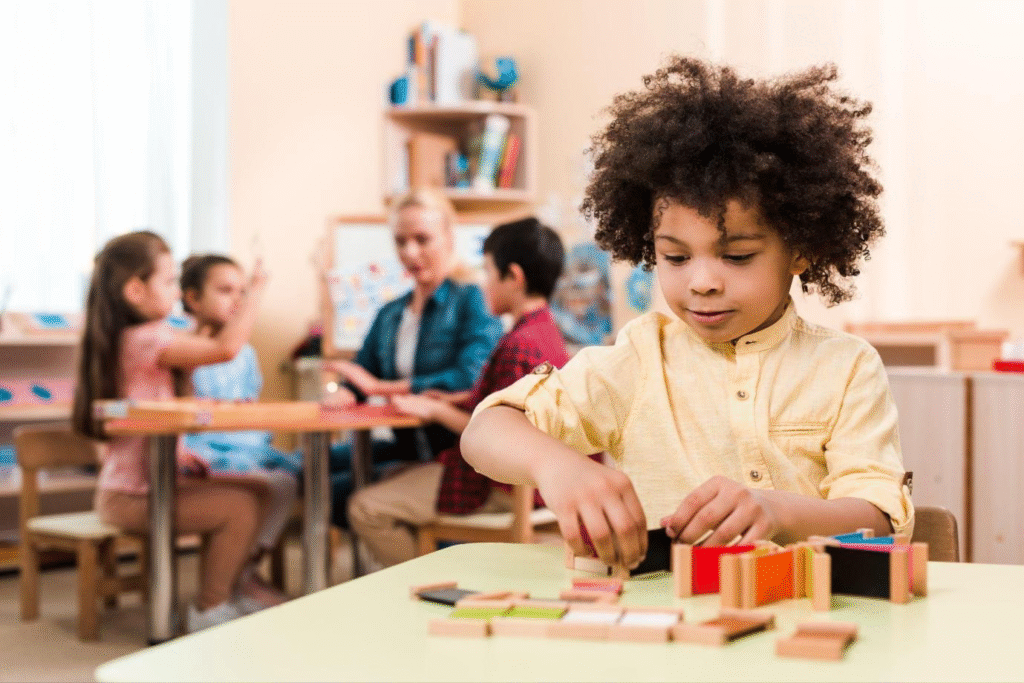
One of the biggest differences parents notice when visiting a Montessori school in Chino is the classroom environment.
A Montessori classroom often feels calmer and more purposeful than a traditional preschool setting.
Instead of every child doing the exact same activity at the same time, children are encouraged to work at their own pace using hands-on learning materials.
You may see:
- One child practicing counting activities
- Another learning language skills
- Another working independently on practical life activities
Teachers are there to guide and observe, helping children learn according to their readiness rather than pushing everyone through the same lesson.
For many young children, this learning style feels more natural because they are encouraged to explore, ask questions, and learn through doing.
If you are still comparing learning approaches, we also created a detailed guide on Montessori vs Traditional Preschool: Understanding the Differences for Your Child, where we explain how the two classroom environments compare.
What Age Should a Child Start Montessori Preschool?
One of the most common questions parents ask is:
“What age should my child start preschool?”
For many children, preschool begins somewhere between 2.5 and 3 years old, though every child develops differently.
Some children are ready earlier. Others may simply need more time.
Instead of focusing only on age, it often helps to look at readiness.
Parents may want to consider questions such as:
- Is my child becoming more independent?
- Do they enjoy exploring new environments?
- Are they showing interest in other children?
- Would they benefit from more routine and social interaction?
There is no single perfect answer, and starting earlier is not always better.
The goal is to find the right timing and environment for your child.
If you are unsure about preschool readiness, we also created a guide on What Age Should a Child Start Preschool?, which explains common readiness signs and what parents can expect during the transition.
Montessori vs Traditional Preschool: Which Is Better?
This is another question many parents ask during their preschool search.
The honest answer is that it depends on your child.
Some children do well in structured, teacher-led environments, while others thrive in classrooms that encourage more independence and hands-on learning.
Generally speaking, traditional preschool classrooms tend to follow group instruction, where children participate in the same activities together.
Montessori classrooms are more individualized, allowing children to progress based on readiness while still following a structured environment.
Here is a quick comparison:
| Montessori Preschool | Traditional Preschool |
| Child-led learning | Teacher-led learning |
| Hands-on materials | Group lessons and worksheets |
| Learn at individual pace | Whole class learns together |
| Mixed-age classrooms | Same-age classrooms |
| Focus on independence | Focus on routine and structure |
| Teacher acts as a guide | Teacher leads instruction |
Neither option is automatically better for every child.
The better question may be:
Which environment will help my child feel confident, supported, and excited to learn?
If you would like a deeper breakdown, you can also read our guide on Montessori vs Traditional Preschool: Understanding the Differences for Your Child.
According to the American Montessori Academy,Montessori and traditional preschool environments often differ in classroom structure, learning pace, teacher roles, and levels of independence encouraged in children.
How to Choose the Right Montessori Preschool in Chino?
Many schools look wonderful online.
But when parents start touring schools, they quickly realize there can be big differences between environments.
If you are comparing a Montessori preschool in Chino, CA, here are a few practical things worth paying attention to.
- Classroom Environment
Does the classroom feel calm, organized, and welcoming?
Children should appear comfortable, engaged, and actively learning rather than overwhelmed or distracted.
- Teacher Interaction
Observe how teachers communicate with children.
Do they seem patient and encouraging? Are children comfortable approaching them?
Young children learn best when they feel emotionally safe and supported.
- Program Fit
The right preschool is not always the same for every child.
Consider whether the school offers programs that fit your child’s age, personality, and learning style.
- Parent Communication
Strong communication between school and parents often makes preschool transitions much smoother.
Ask how updates are shared and how teachers communicate about your child’s progress.
If you would like a deeper guide, we also created How to Choose the Best Montessori Preschool in Chino, CA for Your Child, which covers what parents should look for during school visits in greater detail.
Understanding Preschool Programs by Age
Many Montessori schools offer programs based on developmental stages rather than only age.
Understanding these stages can help parents choose a classroom environment that feels appropriate and supportive.
Toddler Programs (Around 24–36 Months)
Toddler programs are often a child’s first introduction to a classroom environment.
At this stage, the focus is usually on:
- Independence
- Language development
- Social comfort
- Building routines
Children are gradually introduced to classroom expectations in a gentle and supportive way.
– Early Preschool (Around Ages 2–3.5)
Children at this age are often curious, active, and eager to explore.
Early preschool programs usually focus on helping children build confidence, communication skills, and comfort in group environments.
– Preschool (Around Ages 3–5)
This stage often includes stronger focus on language, practical life skills, social development, and early academics.
Children begin building longer attention spans while becoming more independent learners.
– TK & Kindergarten Readiness
For older children, Montessori programs often focus on school readiness while continuing to support confidence, independence, and emotional growth.
A strong transition into kindergarten can often help children feel more prepared academically and socially.
What Parents Should Look For During a School Tour
For many families, visiting a school in person is the moment when things start to feel clearer.
A website can tell you about programs and philosophy, but walking through the classroom often gives parents a much better sense of whether the environment feels right for their child.
If you are touring a Montessori preschool in Chino, CA, here are a few things worth paying attention to.
– How Children Interact in the Classroom
Do children seem engaged and comfortable?
In a Montessori classroom, you will often notice children working independently or in small groups, moving calmly between activities, and staying focused on tasks.
The classroom does not need to be perfectly quiet, but it should generally feel calm, purposeful, and welcoming.
– Teacher and Child Interaction
Watch how teachers communicate with children.
Are they patient and encouraging? Do they guide children respectfully?
Young children learn best when they feel emotionally safe, supported, and comfortable asking for help.
– Classroom Environment
Look around the space itself.
Is the classroom organized and child-friendly? Are materials placed where children can access them independently?
A well-prepared Montessori classroom should feel intentionally designed around children rather than adults.
– Communication With Families
Preschool works best when parents and teachers work together.
You may want to ask:
- How are updates shared with families?
- How do teachers communicate concerns or progress?
- What support is provided during the transition period?
Strong communication can make a big difference, especially during the first few weeks of preschool.
Sometimes, spending just 20 to 30 minutes observing a classroom can tell parents more than hours of online research.
Questions Families Often Ask Before Enrolling
Many parents have similar concerns during the preschool search process.
1. Will Montessori Prepare My Child for Kindergarten?
This is one of the most common questions.
For many families, Montessori education supports kindergarten readiness by helping children build independence, confidence, concentration, communication skills, and early academic foundations.
Rather than only focusing on memorization, Montessori classrooms often encourage children to understand concepts through hands-on learning.
Many children transition very smoothly into kindergarten because they are already comfortable with routines, responsibility, and independent thinking.
2. Is Montessori Too Independent for Young Children?
Not usually.
While Montessori encourages independence, children are still supported every step of the way.
Teachers guide children carefully while helping them gradually build confidence through age-appropriate responsibilities.
The classroom is structured, but children are given more opportunities to explore and learn at their own pace.
3. Is Montessori Only for Certain Types of Children?
Not at all.
Some parents worry Montessori is only for highly independent or academically advanced children.
In reality, Montessori often works well for many different personalities because children are allowed to develop at their own pace.
Some children benefit from extra independence, while others simply enjoy the calm and hands-on learning environment.
The key is finding a school environment that genuinely fits your child’s needs.
Why Some Families Consider Trilingual Montessori Programs?
Many families today are also interested in programs that expose children to more than one language during the early years.
Young children naturally absorb language differently from older children, which is why some parents explore multilingual learning environments during preschool.
For families in Chino, a trilingual Montessori program can offer opportunities for children to be introduced to languages such as English, Mandarin, and Spanish through everyday classroom experiences.
Beyond language development, many parents appreciate the cultural exposure and communication benefits that come from multilingual environments.
Of course, every family has different priorities, and language enrichment is only one piece of the preschool experience.
The most important factor is still finding an environment where your child feels comfortable, supported, and excited to learn.
Why Families Often Visit More Than One School?
If you are still deciding, it is completely normal to visit multiple schools before making a decision.
Many parents do not know what feels “right” until they have seen different classroom environments in person.
One school may feel more structured, another more nurturing, and another may simply feel like a better personality fit for your child.
Sometimes the decision becomes much clearer after a few visits.
You may even notice your child reacting differently in different environments.
The goal is not to rush the decision.
It is to find a place where your child feels supported, confident, and happy during these important early years.
Final Thoughts
Finding the right Montessori preschool in Chino, CA can take time, and it is completely normal to have questions during the process.
The best preschool is not always the one with the biggest promises or nicest website. It is the environment where your child feels safe, encouraged, and genuinely excited to learn.
Every child develops differently, and choosing a preschool is ultimately about finding the environment that best supports your child’s personality, learning style, and growth.
If you are still exploring preschool options, visiting classrooms, speaking with teachers, and asking thoughtful questions can often make the decision feel much clearer.