Many parents start their preschool search thinking all schools are more or less the same – until they come across the word Montessori.
Suddenly, the questions start.
What is the difference?
Is Montessori actually better than traditional preschool?
Will my child learn enough?
Which environment is the right fit for my child?
If you are comparing a Montessori preschool with a traditional preschool, understanding how each approach works can make the decision much clearer.
While both are designed to support early childhood development, the classroom experience, teaching style, and daily routine can feel very different. Knowing these differences can help you choose an environment that fits your child’s personality, learning style, and needs.
What Is a Traditional Preschool?
A traditional preschool usually follows a teacher-led learning approach.
Teachers guide the class through a structured schedule that may include circle time, story time, group lessons, crafts, outdoor play, and early academic activities.
Most children in the classroom learn the same thing at the same time and follow a predictable daily routine.
For some children, this structure works very well. It can provide consistency, clear expectations, and familiarity throughout the school day.
Traditional preschool often focuses on:
- Group learning and classroom participation
- Following routines and instructions
- Early academic readiness
- Social interaction through shared activities
For children who enjoy structure and routine, this environment may feel comfortable and familiar.
What Is a Montessori Preschool?
A Montessori preschool takes a different approach to learning.
Instead of every child completing the same activity at the same time, children are encouraged to learn at their own pace through hands-on materials and guided exploration.
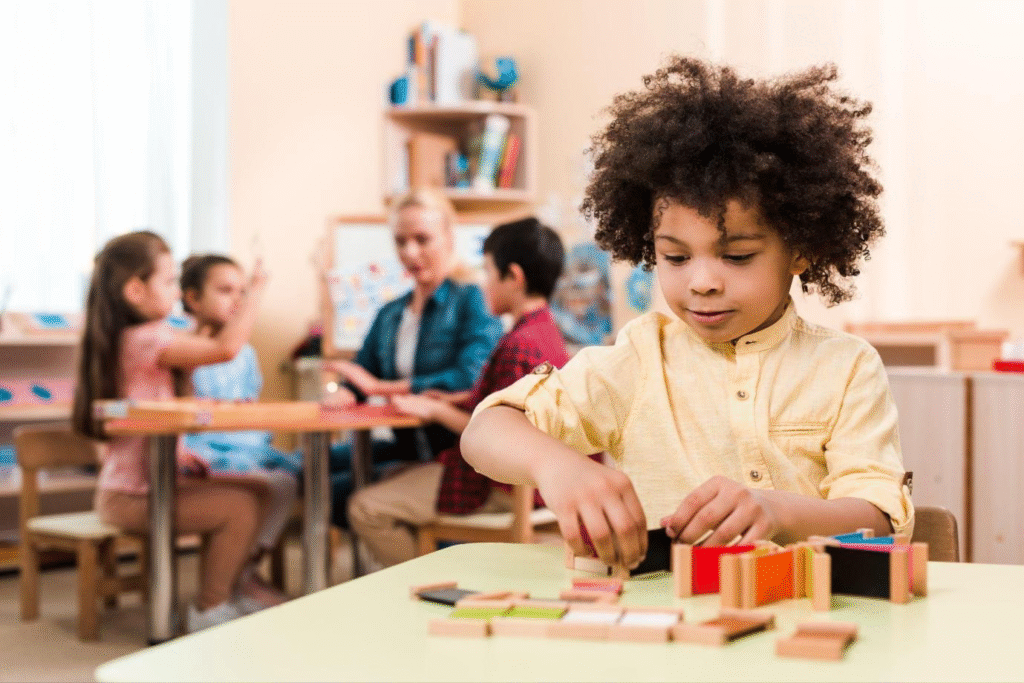
In a Montessori classroom, you may see one child working on counting activities, another practicing language skills, while another learns practical life skills such as organizing materials or preparing simple snacks.
The classroom is designed to encourage independence while still providing structure and guidance.
Teachers play an important role too – but instead of leading every activity, they observe, guide, and introduce lessons based on each child’s readiness and interests.
For many families, this approach helps children develop confidence, concentration, independence, and a stronger love for learning.
If you are new to Montessori education, learning more about the Montessori philosophy can help you better understand how this learning approach works in practice.
Montessori vs Traditional Preschool: What Are the Key Differences?
While both environments help children grow and prepare for school, the day-to-day experience often looks quite different.
According to the American Montessori Academy, Montessori and traditional preschool classrooms differ in areas such as learning style, classroom structure, teacher involvement, and how children progress through learning.
| Montessori Preschool | Traditional Preschool |
| Child-led learning | Teacher-led learning |
| Hands-on materials | Group lessons and worksheets |
| Learn at individual pace | Whole class learns together |
| Mixed-age classrooms | Same-age classrooms |
| Focus on independence | Focus on routine and structure |
| Teacher acts as a guide | Teacher leads instruction |
These differences may seem small at first, but they often shape how children experience learning every day.
Learning Style: Child-Led vs Teacher-Led
One of the biggest differences between Montessori vs traditional preschool is how children learn.
In a traditional preschool, teachers usually guide the class together. Children often participate in the same lesson, activity, or project at the same time.
In Montessori, learning is more individualized.
Children choose activities based on their interests and readiness while working within a carefully prepared classroom environment.
This does not mean Montessori classrooms are unstructured.
In fact, Montessori classrooms are intentionally designed to help children develop focus, responsibility, and independence through meaningful activities.
For many young children, learning through doing can feel more natural than simply listening.
Classroom Environment and Daily Routine
When parents visit schools, this is often one of the first differences they notice.
Traditional preschool classrooms are usually designed around group instruction, with teachers leading activities for the whole class.
A Montessori classroom often feels calmer and more child-centered.
Materials are placed on accessible shelves, furniture is designed for children, and students are encouraged to move independently between activities.
You will often see children actively engaged rather than waiting for instructions.
For many families, this environment feels more aligned with how young children naturally explore and learn.
Independence and Confidence
Another major difference is the focus on independence.
Young children naturally want to try things on their own. Whether it is pouring water, cleaning up toys, or choosing an activity, these small moments help build confidence over time.
In a Montessori preschool, children are encouraged to take responsibility in age-appropriate ways.
Rather than depending on adults for every step, they gradually learn problem-solving, decision-making, and responsibility through everyday classroom experiences.
Many parents notice their children becoming more confident and independent after spending time in a Montessori environment.
Social Development and Mixed-Age Learning
Most traditional preschools separate children strictly by age.
Montessori classrooms often mix children of different age groups together.
This allows younger children to observe and learn from older classmates, while older children naturally develop patience, confidence, and leadership skills.
Instead of competition, the classroom often feels more collaborative.
Children learn how to communicate, help one another, and develop social confidence naturally throughout the day.
Which Preschool Is Better for Your Child?
There is no one-size-fits-all answer.
Some children thrive in a highly structured classroom with clear routines. Others do better in environments that encourage independence, hands-on learning, and self-paced exploration.
When comparing a Montessori preschool with a traditional preschool, it helps to ask:
- Does my child enjoy independence?
- Does my child learn best through movement and hands-on activities?
- Would my child benefit from a structured group setting?
- What kind of learning environment feels most comfortable?
The best preschool is usually the one where your child feels supported, confident, and excited to learn.
If you are still exploring options, our guide on How to Choose the Right Montessori Preschool in Chino, CA for Your Child may also help you know what to look for during a school tour.
Why Many Families Choose Montessori in Chino
For many families, Montessori feels like a natural fit during the early years because children are encouraged to learn through curiosity, movement, and exploration.
At EverBright Montessori Academy, we support children through different stages of early childhood with programs designed for toddler, preschool, and kindergarten readiness.
Families can also explore enrichment opportunities in languages, STEAM, physical education, and arts, helping children grow both academically and socially.
Most importantly, we believe children learn best when they feel supported, encouraged, and excited about learning.
If you would like to experience the classroom environment firsthand, scheduling a school tour can be one of the best ways to understand whether Montessori feels right for your child.
Final Thoughts
When comparing Montessori vs traditional preschool, the goal is not to find a perfect answer that works for every child.
It is about understanding the differences and finding an environment where your child can feel confident, supported, and ready to learn.
Both approaches have strengths, but understanding how children experience each classroom can help parents make a more informed decision.
Sometimes, seeing the classroom in person makes the decision much clearer than anything you read online.