The year before kindergarten is a period of remarkable growth. Four- and five-year-olds are developing language, early academics, coordination, concentration, social awareness, independence, and confidence, often all at the same time.
For parents researching transitional kindergarten in Chino, California, the name of the program is only one part of the decision. What matters just as much is what children experience each day.
Will they be expected to progress at one pace, or can learning be adjusted to their readiness? Will they spend meaningful time working with hands-on materials? How much independence will they develop? How will teachers respond when they are ready for more challenge in one area but need additional practice in another?
At EverBright Montessori Academy, families looking for education during this important stage can explore a Montessori TK & Kindergarten program built around individualized learning, mixed-age classrooms, hands-on experiences, and the gradual development of independence.
Understanding how this approach works can help parents decide what they want the year before kindergarten to accomplish for their child.
What Should Children Be Developing During the TK Years?
The TK-age years are about much more than learning letters and numbers.
California’s Preschool/Transitional Kindergarten Learning Foundations describe children’s development across nine broad areas, including language and literacy, mathematics, science, social and emotional development, physical development, approaches to learning, health, history-social science, and visual and performing arts.
This whole-child view matters because children rarely develop every skill at the same speed.
A four- or five-year-old might be:
- Beginning to read simple words while still strengthening pencil control
- Comfortable with numbers but hesitant to speak in a group
- Highly independent with practical tasks but still learning how to manage frustration
- Curious about science and nature while developing longer periods of concentration
- Socially confident but still building early writing skills
A strong learning environment recognizes these differences rather than expecting every child of the same age to perform identically.
The National Association for the Education of Young Children also emphasizes developmentally appropriate learning that considers each child’s individual strengths, experiences, development, and context.
For parents, this means the year before kindergarten should not become a race to complete a checklist early.
It should give children opportunities to grow academically while also becoming more capable, curious, responsible, and confident learners.
How Does Montessori Approach Transitional Kindergarten?
Montessori education approaches the TK years as part of a continuous period of development rather than treating a child’s birthday as the main factor determining what they should learn next.
The American Montessori Society’s description of Early Childhood Montessori explains that children work in a prepared environment with hands-on materials, meaningful choices, individualized guidance, and uninterrupted periods of work.
Instead of moving the entire class through the same activity at the same moment, teachers observe individual children and introduce lessons based on readiness.
That distinction can be especially valuable around ages four and five.
A child who is moving quickly in mathematics does not necessarily need to wait for the rest of the class. A child who needs more repetition with letter sounds can continue practicing without being pushed forward before the foundation is secure.
At EverBright Montessori Academy, the TK & Kindergarten program describes this as an individualized approach. Students can be grouped according to ability and interest within mixed-age classrooms rather than relying only on age.
This gives children room to progress in different areas at different rates.
Why Individualized Learning Matters at Age Four and Five
Development during the TK years can be uneven, and that is normal.
A child may have a sophisticated vocabulary but still be learning how to organize their belongings. Another may solve mathematical problems confidently but need more time to develop writing control. A child who is socially outgoing may struggle with sustained attention, while a quieter child may concentrate deeply on complex work.
An individualized environment allows these strengths and needs to exist together.
Instead of asking, “Is this child ahead or behind?” Montessori teachers can look more specifically at what the child is ready to learn next.
That changes the educational question.
Rather than:
What should every five-year-old be doing right now?
The question becomes:
What is this child ready to work on next?
For parents who want a deeper explanation of this philosophy, EverBright Montessori Academy’s guide to what the Montessori Method is explains how prepared environments, observation, independence, and child-led learning work together.
What Does a Montessori TK Curriculum Include?
Montessori education combines academic development with practical, sensory, social, and cultural learning.
During the TK years, children may be working across five interconnected areas of the Montessori curriculum.
Practical Life
Practical Life gives children meaningful opportunities to practice independence, coordination, concentration, order, and responsibility.
Activities may involve pouring, transferring, fastening, cleaning, organizing, preparing materials, or caring for the classroom environment.
The task itself may appear simple, but completing it requires children to remember a sequence, control their movements, concentrate, notice mistakes, and finish what they started.
These abilities become increasingly useful as children prepare for kindergarten and elementary school.
Sensorial
Sensorial materials help children observe and classify qualities such as size, shape, dimension, color, texture, weight, and sound.
Children compare, arrange, match, grade, and identify differences.
This work strengthens observation and lays foundations that connect naturally with mathematics, geometry, language, and scientific thinking.
Language
Montessori language work develops spoken language, vocabulary, phonemic awareness, writing, and reading through carefully sequenced experiences.
Children can work with materials such as Sandpaper Letters and the Movable Alphabet, using touch, movement, sight, and sound together.
EverBright Montessori Academy’s Preschool program specifically describes multisensory language experiences using materials such as sandpaper letters, movable letters, and phonetic readers.
By the TK years, children who are ready can continue progressing into increasingly complex reading and writing work.
Mathematics
Montessori mathematics begins with concrete experiences.
Rather than encountering numbers only as symbols written on a page, children use physical materials to explore quantity, counting, place value, operations, patterns, and mathematical relationships.
The goal is to help children understand what numbers mean before relying only on memorized procedures.
Cultural Studies
Cultural learning can include geography, science, nature, art, music, history, and the wider world.
Children classify plants and animals, explore maps, learn scientific vocabulary, observe nature, and investigate topics that expand their understanding beyond the immediate classroom.
Parents who want a deeper look at these areas can explore The 5 Areas of the Montessori Curriculum.
How Do Montessori Materials Support TK-Age Learning?
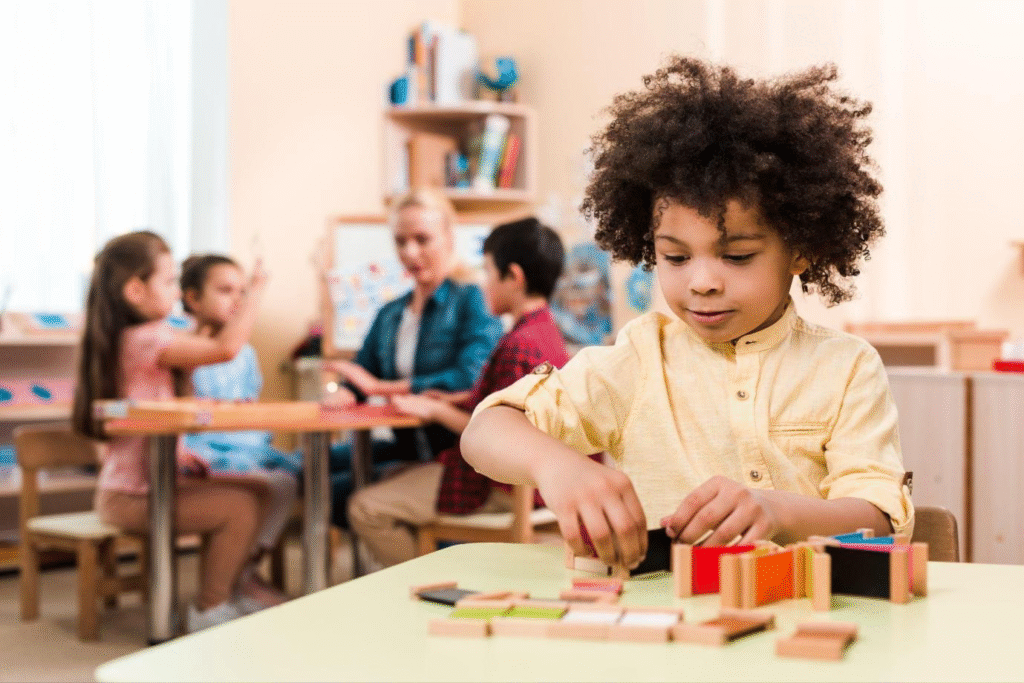
Montessori classrooms look different partly because children learn with specially designed hands-on materials.
A child may trace textured letters, arrange number beads, build geometric forms, classify objects, work with maps, or complete a Practical Life sequence.
These materials are not simply classroom toys.
They are designed to isolate particular concepts and allow children to learn through direct experience.
Many also contain a built-in way for children to recognize mistakes. Instead of immediately waiting for an adult to tell them whether something is correct, children can often notice that a piece does not fit, a sequence is incomplete, or a quantity does not match.
That process supports independent problem-solving.
Children learn to pause, observe, adjust, and try again.
EverBright Montessori Academy’s guide to how Montessori materials build real-life skills explains how these materials support concentration, coordination, independence, problem-solving, and academic understanding.
For TK-age children, this hands-on progression can help make increasingly complex ideas concrete and understandable.
How Montessori TK Supports Early Reading and Writing
Parents often begin thinking more seriously about literacy as kindergarten approaches.
Should a child already be reading?
How well should they write?
How many letters should they know?
There is no single point every child must reach at exactly the same age.
Montessori language education follows a sequence that allows children to build skills gradually.
Children may first strengthen spoken language and vocabulary, then work with letter sounds, sound-symbol relationships, word building, writing, and eventually reading.
The use of multisensory materials can help make these abstract skills more concrete.
At EverBright Montessori Academy, the TK & Kindergarten program includes language arts and literature. The school’s program information also describes work in phonics, vocabulary, grammar, reading, and writing.
A child who is ready to advance can continue forward. A child who needs additional repetition can keep strengthening the foundation.
The purpose is not simply to make children read as early as possible.
It is to help them become capable readers and writers while preserving confidence and interest in learning.
How Montessori TK Develops Mathematical Understanding
The same principle applies to mathematics.
Young children can memorize numbers without fully understanding quantities or relationships between them.
Montessori mathematics materials make those relationships visible and touchable.
Children may physically count objects, compare quantities, organize number sequences, combine amounts, or explore the decimal system using concrete materials before moving toward abstract notation.
This concrete-to-abstract progression allows children to experience mathematical ideas before being expected to work only with written symbols.
At EverBright Montessori Academy, mathematics is one of the core academic areas described within the TK & Kindergarten program.
As with language, individualized progression allows a child who is ready for more complex work to continue developing without requiring every classmate to reach the same lesson at the same time.
Independence Is Part of Kindergarten Readiness
One of the most important changes during the year before kindergarten is often not academic.
It is what children begin doing for themselves.
A child may gradually become more capable of:
- Organizing personal belongings
- Choosing appropriate work
- Gathering necessary materials
- Completing tasks in sequence
- Cleaning up after an activity
- Asking for help appropriately
- Waiting briefly when necessary
- Managing simple frustrations
- Following routines
- Taking responsibility for a shared environment
These abilities support children well beyond the Montessori classroom.
They also reduce the amount of adult direction a child needs throughout the school day.
In Montessori, independence does not mean adults simply leave children alone to figure everything out.
Teachers demonstrate, observe, guide, and intervene when necessary. The difference is that they also make room for children to attempt manageable tasks themselves.
A child who can do something independently is given an opportunity to do it.
Over time, those small experiences can build genuine confidence because the child has evidence of their own growing capability.
Concentration and Self-Regulation Matter Too
The ability to focus, remember instructions, manage impulses, and shift between tasks plays an important role in learning.
According to Harvard University’s Center on the developing child, children gradually develop important skills such as remembering instructions, adapting when situations change, and managing their impulses.
These skills develop gradually throughout childhood.
A Montessori work cycle can give children opportunities to practice several of them naturally.
A child chooses an activity, remembers how to use it, follows a sequence, ignores some distractions, notices mistakes, completes the task, returns the material, and makes another choice.
This type of purposeful independence requires more than academic knowledge.
It requires the child to increasingly manage their own attention and behavior.
Longer periods of uninterrupted work are another important feature of Montessori Early Childhood environments. The American Montessori Society explains that these work periods allow children to remain with meaningful activities instead of being continually interrupted by adult-directed transitions.
For some children, this time is where sustained concentration begins to grow.
What Does Kindergarten Readiness Really Look Like?
Kindergarten readiness is broader than being able to read a short book or count to a certain number.
Academic skills are useful, but children also benefit from communication, independence, coordination, self-regulation, curiosity, and social awareness.
A child approaching kindergarten may be developing the ability to:
- Communicate needs clearly
- Listen during age-appropriate conversations
- Follow familiar routines
- Complete simple multi-step directions
- Interact respectfully with other children
- Work independently for gradually longer periods
- Take care of belongings
- Use pencils, scissors, and classroom tools
- Recognize some letters, sounds, quantities, and patterns
- Stay with a manageable challenge
- Recover after making a mistake
- Ask for assistance when necessary
Children do not need to master every item before kindergarten begins.
EverBright Montessori Academy’s Kindergarten Readiness Checklist for California Parents explores these areas in more detail and can help families identify both emerging strengths and skills that still need practice.
The more helpful question is usually not:
“Is my child ahead enough?”
It is:
“Is my child becoming more capable of participating in learning independently?”
Why Continuity Can Matter During the TK Years
Children often make their strongest progress when they have enough time to become comfortable with an environment and then deepen their learning within it.
A child who already understands the classroom routines does not need to spend the same amount of energy learning where everything belongs, how activities work, what adults expect, and how to navigate an unfamiliar environment.
Instead, that energy can go toward increasingly challenging work.
The mixed-age structure of Montessori also supports continuity.
Children can remain within a familiar educational model while their role naturally changes as they grow. Younger children observe older classmates. Older children gain confidence as they become more experienced members of the classroom community.
This does not mean a child should never experience change.
It means that continuity itself can have educational value, especially when a child is already engaged, comfortable, and making progress.
For parents with a four- or five-year-old who is thriving in Montessori, this is worth considering when planning the year before kindergarten.
What Should Parents Look for in a Montessori TK Program?
A school tour is one of the best ways to understand whether the environment matches what you want for your child.
Do not look only at how attractive the classroom appears.
Watch how people use it.
Are children engaged?
Children do not need to be silent, but their activity should have purpose.
Some may be working independently. Others may be receiving a lesson, speaking quietly with another child, moving materials, or completing a practical task.
Look for engagement rather than constant adult entertainment.
Can children work independently?
Notice whether children can access appropriate materials, choose work they understand, complete activities, and return materials when finished.
How do teachers respond to mistakes?
Mistakes are part of learning.
Watch whether adults immediately correct every error or give children opportunities to notice, think, and attempt a solution.
Can learning be individualized?
Ask what happens when a child is ready for advanced reading or mathematics but needs more time in another area.
The answer can reveal whether individualized learning is truly part of the program or simply a phrase used in marketing.
Is there time for sustained work?
Frequent interruptions can make it difficult for young children to concentrate deeply.
Ask how the daily schedule protects focused learning time.
Does the classroom encourage responsibility?
Look for opportunities children have to care for materials, organize their work, contribute to the environment, and manage age-appropriate tasks themselves.
EverBright Montessori Academy’s Montessori Preschool Tour Checklist provides additional questions parents can use when visiting a Montessori classroom.
Transitional Kindergarten at EverBright Montessori Academy
EverBright Montessori Academy is located in Chino, California and provides an authentic Montessori experience for children ages two through seven.
Its program options include Preschool and TK & Kindergarten.
The TK & Kindergarten program emphasizes individualized learning and joyful mastery of academics across language arts, literature, history, mathematics, and science.
EverBright Montessori Academy describes its approach as different from teaching to the middle of a narrow one-year age group. Students can be grouped according to ability and interest within mixed-age classrooms, allowing learning to respond more closely to individual readiness.
The school’s broader Montessori approach also emphasizes hands-on materials and student-led exploration, with teachers observing, guiding, and supporting children individually.
Parents can learn more about the people guiding these classrooms on the EverBright Montessori Academy teacher page.
For families researching transitional kindergarten in Chino, California, these details are worth seeing in practice rather than only reading about online.
A classroom visit lets you observe how children work, how teachers guide them, how materials are used, and how independence appears during an ordinary school day.
Making the Year Before Kindergarten Count
The year before kindergarten can shape far more than a child’s early reading or mathematics skills.
It is also a year when children can learn to concentrate longer, organize themselves, solve manageable problems, communicate more clearly, care for their surroundings, interact with classmates, and take greater responsibility for their own work.
Those abilities do not develop through one worksheet or one lesson.
They grow through repeated everyday experiences.
For families considering Montessori TK in Chino, the most useful question may therefore be less about how quickly a school can move a child through academic material and more about the kind of learner the environment is helping that child become.
Can your child explore challenging ideas without being rushed?
Can they receive extra practice without feeling left behind?
Can they experience the satisfaction of doing more for themselves?
Can they stay curious as academics become more demanding?
Those are meaningful goals for the TK years and useful foundations for whatever comes next.
See Montessori TK in the Classroom
Reading about Montessori can explain the philosophy, but seeing children use the environment often makes it much easier to understand.
Families considering a TK or Kindergarten program in Chino can schedule a tour of EverBright Montessori Academy to observe the classrooms, meet the educators, and ask how individualized learning works for children approaching kindergarten.
You can also explore the TK & Kindergarten program before your visit or contact EverBright Montessori Academy with questions about programs and enrollment.
The goal is not simply to prepare a child for the first day of kindergarten. It is to give them a strong foundation for learning, independence, and confidence as their education continues.