If you’re exploring preschool options for your child, you’ve probably come across the word Montessori. But what exactly does it mean, and why do so many parents choose it?
Montessori is more than a preschool curriculum. It’s an educational philosophy that helps children become independent, confident, and curious learners through hands-on experiences and carefully prepared environments. Instead of expecting every child to learn the same thing at the same pace, Montessori recognizes that each child develops differently and learns best when they’re ready.
At EverBright Montessori Academy in Chino, California, we follow authentic Montessori principles by creating classrooms where children can explore, make choices, and develop essential life skills with guidance from experienced teachers. Our goal isn’t simply to prepare children for kindergarten, but to help them build a lifelong love of learning.
In this guide, you’ll discover what the Montessori Method is, how it works, what children learn, and how to choose an authentic Montessori school. If you’d like to explore a specific topic in greater detail, we’ve included links to our in-depth guides throughout this article.
What Is the Montessori Method?
The Montessori Method is an educational approach developed by Dr. Maria Montessori, an Italian physician and educator, in the early 1900s. Rather than relying primarily on lectures, worksheets, or memorization, Montessori encourages children to learn by exploring carefully designed materials that help them discover concepts through experience.
In a Montessori classroom, teachers don’t simply deliver the same lesson to every child. Instead, they observe each child’s interests and developmental readiness before introducing new activities. This allows children to progress at their own pace while building confidence through meaningful success.
According to the American Montessori Society (AMS), authentic Montessori education includes trained Montessori educators, uninterrupted work periods, multi-age classrooms, and specially designed learning materials that encourage independence and active learning.
Today, Montessori schools can be found around the world, and many families choose them because they value child-led learning, independence, and whole-child development.
Who Was Dr. Maria Montessori?
Dr. Maria Montessori (1870–1952) was one of Italy’s first female physicians. While working with children, she noticed something remarkable: when children were given the right environment and meaningful activities, they naturally became focused, responsible, and eager to learn.
Her observations led to the opening of the first Casa dei Bambini (Children’s House) in Rome in 1907. From there, her educational philosophy spread internationally and continues to influence schools more than a century later.
The core principles she developed remain the foundation of authentic Montessori education today:
- Respect for every child
- Independence through meaningful work
- Hands-on learning
- Freedom within clear boundaries
- Learning driven by curiosity
You can learn more about Dr. Montessori through the Association Montessori Internationale (AMI), the organization she founded to preserve authentic Montessori education.
The Montessori Philosophy
One of the biggest differences between Montessori and many traditional classrooms is how children are viewed.
Montessori believes children are naturally curious and capable of directing much of their own learning when they’re given the right environment. Instead of asking children to adapt to a rigid teaching schedule, teachers prepare an environment that encourages exploration while providing guidance when it’s needed.
This approach is often described as freedom within limits. Children are free to choose from activities that have already been introduced by their teacher, while learning to respect classroom routines, shared materials, and the people around them.
As children gain confidence in making choices, they also develop concentration, responsibility, problem-solving skills, and self-discipline. These qualities support not only academic success but also social and emotional growth.
At EverBright Montessori Academy, this philosophy influences everything from classroom design to lesson planning. Every child is encouraged to grow at their own pace while feeling supported by caring teachers and a thoughtfully prepared learning environment.
What Makes a Montessori Classroom Different?
Walk into an authentic Montessori classroom and you’ll notice that it feels different from many traditional preschool classrooms.
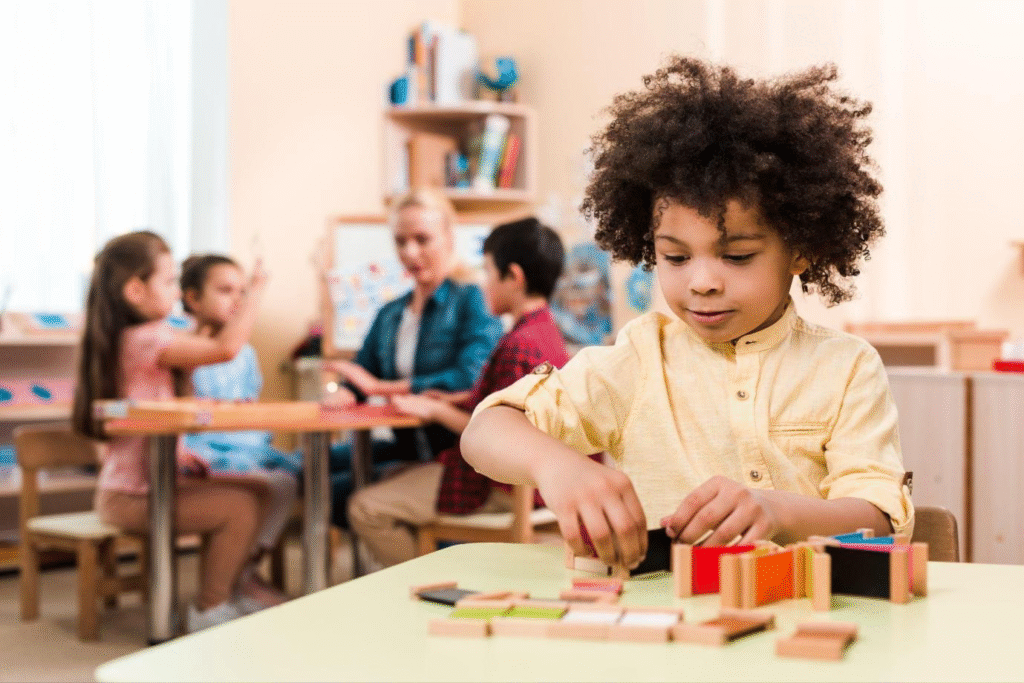
The furniture is child-sized, learning materials are neatly arranged on open shelves, and children move independently between activities they’ve already learned how to use. Rather than completing the same worksheet together, each child may be working on something that matches their own stage of development.
This carefully prepared environment encourages children to become active participants in their own learning instead of simply following instructions.
Another key difference is the role of the teacher. Montessori educators act as guides who observe each child closely, introduce new lessons at the appropriate time, and encourage children to solve problems independently whenever possible.
Together, the prepared environment and the teacher create a learning experience that supports confidence, independence, and genuine curiosity.
One of the most common questions parents ask after seeing a Montessori classroom is, “What exactly do children learn here?” In the next section, we’ll look at the five learning areas that form the foundation of the Montessori curriculum, while linking to a more detailed guide if you’d like to explore each one further.
What Do Children Learn in Montessori?
Rather than focusing only on academic achievement, Montessori education is designed to develop the whole child. Children gradually build independence, confidence, critical thinking, communication, and practical life skills through carefully prepared, hands-on learning experiences that match their stage of development.
The curriculum is organized into five interconnected learning areas: Practical Life, Sensorial, Language, Mathematics, and Cultural Studies. Instead of treating these as separate subjects, Montessori allows children to make connections between different concepts while learning through exploration and real-world experiences.
Each learning area has its own purpose and sequence of lessons. Together, they create a balanced foundation that supports children’s intellectual, social, emotional, and physical development. If you’d like to understand how each learning area works, the Montessori materials children use, and the skills children develop at every stage, explore our complete guide to the 5 Areas of the Montessori Curriculum.
Why Montessori Still Matters Today
Although the Montessori Method was developed more than a century ago, its philosophy remains highly relevant today. Children are still naturally curious, and they continue to learn best through meaningful experiences, active exploration, and supportive relationships.
Many parents today are looking beyond early academic success. They want their children to become confident, adaptable, creative, and capable of thinking independently. Montessori supports these qualities by encouraging children to make choices, solve problems, collaborate with others, and take responsibility for their own learning from an early age.
At EverBright Montessori Academy, these principles are part of everyday classroom life. Children aren’t expected to memorize information or keep pace with the rest of the class. Instead, they are guided according to their individual development, helping them build confidence while enjoying the learning process.
If you’re wondering what this looks like in practice, our article A Day in Montessori Preschool takes you through a typical Montessori school day, from morning arrival to afternoon pick-up, so you can see how Montessori principles come to life in the classroom.
What Are the Benefits of Montessori Education?
Every educational approach has its own strengths, and the Montessori Method is no exception. Rather than focusing only on preparing children for the next grade level, Montessori aims to help children develop the skills and attitudes they’ll use throughout their lives.
Some of the most widely recognized benefits of Montessori education include:
- Developing independence through meaningful daily activities.
- Building concentration with uninterrupted work periods.
- Supporting each child’s individual pace of learning.
- Encouraging problem-solving and critical thinking through hands-on experiences.
- Fostering confidence, responsibility, and intrinsic motivation.
- Nurturing social and emotional development through collaboration and respect for others.
These outcomes are possible because every part of the Montessori classroom, from the prepared environment to the role of the teacher, is intentionally designed to support children’s natural development rather than simply deliver information.
Of course, no educational approach is the perfect fit for every child. The quality of the school, the training of the teachers, and how faithfully Montessori principles are implemented all play an important role in a child’s experience.
Research over the past several decades has shown encouraging results for authentic Montessori programs, particularly in areas such as academic achievement, executive function, creativity, and social development. We’ll look at what the research says next before exploring how Montessori compares with other early childhood education options.
What Does Research Say About Montessori Education?
Parents often ask whether Montessori is supported by research or whether it’s simply a different teaching philosophy. While no educational approach can guarantee the same outcomes for every child, a growing body of research suggests that authentic Montessori education can positively support children’s academic, cognitive, and social development.
One of the most well-known studies, published in the journal Science, found that children attending high-fidelity Montessori schools performed better in areas such as reading, mathematics, executive function, and social understanding than children in conventional schools. A review published in Frontiers in Psychology also concluded that authentic Montessori programs are generally associated with positive outcomes in academic achievement, creativity, executive function, and social development.
Research from Harvard University’s Center on the Developing Child further highlights that young children learn best through responsive relationships, meaningful experiences, and active exploration play a critical role in early childhood development. These principles closely align with the Montessori approach, which encourages children to learn through hands-on experiences in a carefully prepared environment.
It’s important to note that these findings apply to authentic Montessori programs. Because the term “Montessori” isn’t legally protected in many countries, schools can vary significantly in how closely they follow the philosophy. That’s why it’s important to look beyond the school’s name and understand how Montessori is implemented in the classroom.
How Is Montessori Different from Traditional Preschool?
Both Montessori and traditional preschool aim to prepare children for future learning, but they take different approaches to helping children grow.
Traditional preschools often follow a teacher-led curriculum where the class learns the same lesson together. Montessori classrooms, on the other hand, encourage children to learn through hands-on exploration, with teachers guiding each child according to their individual readiness and developmental pace.
Neither approach is universally better. The right choice depends on your child’s personality, learning style, and the type of environment where they will feel most confident and supported.
If you’re comparing both options, we’ve created a detailed guide that explains the differences in teaching methods, classroom structure, daily routines, and learning outcomes in our article on Montessori vs. Traditional Preschool.
Montessori vs. Daycare
Parents also commonly compare Montessori with daycare because both provide a safe environment for young children. However, they are designed with different primary goals.
Daycare focuses mainly on providing dependable childcare while parents are at work, often incorporating play-based activities throughout the day. Montessori combines childcare with a structured educational philosophy that encourages children to develop independence, concentration, confidence, and practical life skills through purposeful, hands-on learning experiences.
Many families choose Montessori because they’re looking for both quality care and an educational environment that supports their child’s overall development.
If you’re deciding between the two, our detailed Montessori vs. Daycare guide compares classroom environments, daily routines, teacher roles, costs, and what children typically experience in each setting.
Is Montessori Right for Every Child?
One of the most common questions parents ask is whether Montessori is the right fit for their child.
The honest answer is that no educational approach is perfect for every family. Every child has a unique personality, learning style, and pace of development. What matters most is finding a learning environment where your child feels safe, respected, and excited to learn.
Many children thrive in Montessori because they enjoy exploring, making choices, and learning through hands-on experiences. Others may need time to adjust, especially if they’re coming from a more teacher-directed environment. With consistent routines and supportive guidance, many children gradually become more confident, independent, and engaged in their learning.
If you’re unsure whether Montessori is the right choice, visiting the school, observing a classroom, and speaking with the teachers can often provide far more insight than reading online reviews alone.
At EverBright Montessori Academy, we encourage families to schedule a tour so they can experience our classrooms firsthand and decide whether our learning environment is the right fit for their child.
Common Montessori Misconceptions
Because Montessori is different from many traditional education models, it’s often misunderstood. Let’s look at a few common myths.
“Montessori children can do whatever they want.”
One of the biggest misconceptions is that Montessori classrooms have no rules or structure. In reality, Montessori encourages freedom within limits. Children are free to choose from activities that have already been introduced by their teacher, while learning to respect classroom routines, shared materials, and the people around them.
“Montessori isn’t academic.”
Montessori absolutely includes language, mathematics, science, geography, and cultural studies. The difference is that children first build understanding through hands-on experiences before moving to abstract concepts. This approach focuses on genuine understanding rather than memorization.
“Montessori is only for gifted or highly independent children.”
Montessori is designed for children with a wide range of personalities, interests, and learning styles. Because teachers observe each child’s readiness and introduce lessons individually, children can progress at a pace that suits their own development instead of being expected to keep up with the rest of the class.
How to Choose an Authentic Montessori School
Not every school using the word Montessori follows authentic Montessori principles. In many countries, including the United States, the name isn’t legally protected, so it’s important to look beyond the school’s branding.
When visiting a Montessori school, consider asking questions such as:
- Are the teachers Montessori trained?
- Does the classroom use authentic Montessori materials?
- Is the learning environment organized and child-centered?
- Do children have uninterrupted work periods?
- Are children engaged, independent, and enjoying their learning?
Observing the classroom is often one of the best ways to understand whether a school genuinely follows Montessori principles.
If you’re currently comparing schools, our guide on How to Choose the Best Preschool in Chino, CA shares practical questions to ask during school tours and explains what parents should look for before making a decision.
Why Families Choose EverBright Montessori Academy
At EverBright Montessori Academy, we believe every child deserves an environment where they feel respected, supported, and inspired to learn.
Our classrooms follow authentic Montessori principles while providing a warm, welcoming atmosphere where children develop confidence through meaningful experiences. Teachers carefully observe each child’s progress, introduce lessons at the right time, and encourage independence every step of the way.
Families also value our close partnership with parents. Open communication and a shared commitment to each child’s growth help create a positive learning experience both at school and at home.
Whether your child is just beginning their early learning journey or preparing for kindergarten, our programs are designed to nurture curiosity, build confidence, and establish a strong educational foundation.
Final Thoughts
The Montessori Method has helped children develop independence, confidence, and a lifelong love of learning for more than a century. While educational trends continue to evolve, the core philosophy of respecting each child’s natural development remains as relevant as ever.
Choosing the right preschool is about more than academics. It’s about finding a learning environment where your child feels safe, supported, and excited to learn every day.
We hope this guide has given you a clearer understanding of what Montessori education is and how it can benefit young children. If you’re considering Montessori for your family, there’s no better way to experience it than by visiting a classroom, meeting the teachers, and seeing the learning environment firsthand.
If you’d like to learn more about EverBright Montessori Academy or schedule a tour, we’d love to welcome your family and answer any questions you may have.