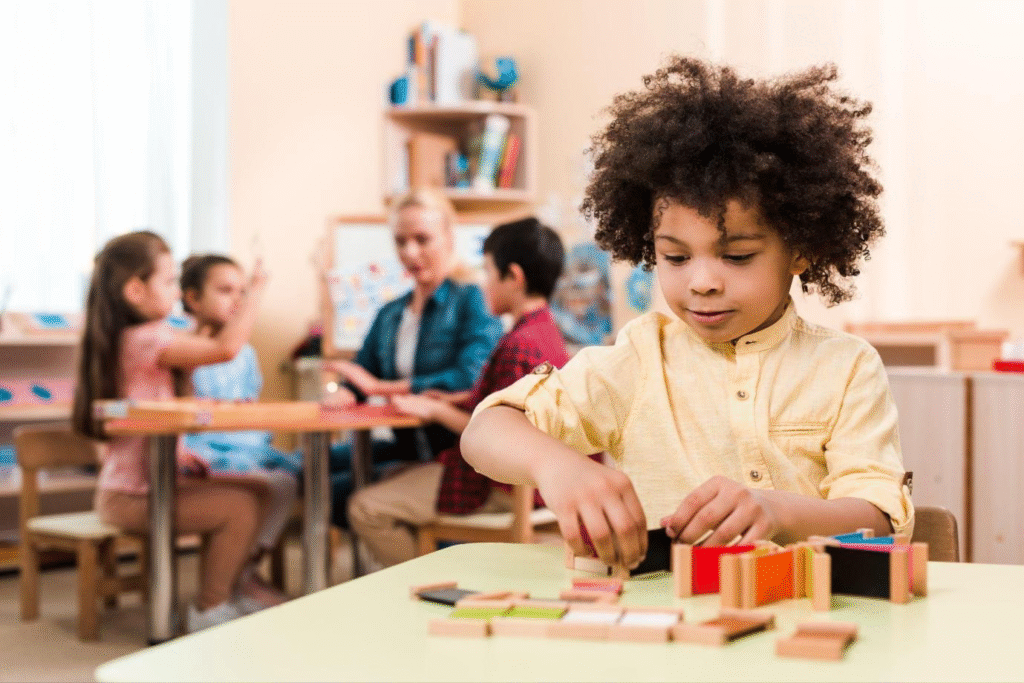
A child carefully pours water from a small pitcher into a glass. Nearby, another child traces a textured letter with two fingers, while a classmate arranges wooden cubes from largest to smallest.
These activities may look simple, but each one has been thoughtfully designed to support a specific stage of development.
Montessori materials are not ordinary classroom toys. They are purposeful learning tools that help children explore ideas through movement, touch, repetition, and discovery. As children work with them, they develop academic understanding alongside practical abilities such as concentration, coordination, independence, and problem-solving.
Understanding what Montessori materials are can help parents see why the classroom may look different from a conventional preschool and how hands-on work prepares children for everyday life.
What Are Montessori Materials?
Montessori materials are specially designed learning tools used within the Montessori Method. They help children understand one concept or practice one skill at a time through direct, hands-on experience.
Instead of listening to a long explanation about size, quantity, shape, sound, or language, children work with objects that make those ideas visible and tangible.
For example, a child may:
- Compare wooden cylinders to understand differences in dimension
- Trace textured letters while hearing their sounds
- Count beads to connect written numbers with real quantities
- Practice fastening buttons before dressing independently
- Arrange objects from smallest to largest to develop sequencing skills
The Association Montessori Internationale’s overview of Montessori education for ages 3 to 6 explains that children at this stage learn through real-life activities, concrete sensory experiences, movement, exploration, and opportunities to work at their own pace.
Montessori materials support this natural way of learning. Children do not simply receive information. They handle it, test it, repeat it, and gradually make sense of it for themselves.
What Makes Montessori Materials Different?
Montessori materials have several features that distinguish them from many conventional classroom resources.
1. Each Material Has a Clear Purpose
A Montessori material usually isolates one quality or concept.
A color-matching activity focuses on differences in color. A set of sound cylinders draws attention to variations in sound. A number activity helps children connect quantities with symbols.
By limiting unnecessary distractions, the material allows the child to concentrate on the skill being practiced.
2. Children Learn From Concrete Experiences
Young children often understand ideas more easily when they can see and touch them.
Montessori education commonly follows a concrete-to-abstract progression. Children first explore a concept with physical materials before working with symbols or ideas on paper.
The American Montessori Society’s explanation of concrete-to-abstract learning uses the Golden Beads as an example. Children physically handle units, tens, hundreds, and thousands before being expected to understand the decimal system in an abstract form.
3. Many Materials Help Children Notice Mistakes
Montessori materials often contain a built-in control of error. This means the child can recognize when something does not fit, match, balance, or follow the intended sequence.
A cylinder may not fit into the remaining space. A tower may appear uneven. A counting activity may have pieces left over.
The child receives feedback from the material instead of immediately depending on an adult to identify the mistake. This encourages careful observation, persistence, and independent problem-solving.
4. Materials Are Arranged for Independent Use
In a prepared Montessori environment, materials are displayed neatly on accessible shelves. Children can see their choices, select work they have been shown how to use, carry it to an appropriate space, complete the activity, and return it when finished.
This complete process teaches more than the lesson contained within the material. It also develops order, responsibility, decision-making, and respect for a shared environment.
The Main Types of Montessori Materials
Montessori materials are generally organized across five connected curriculum areas: Practical Life, Sensorial, Language, Mathematics, and Cultural Studies.
The following overview focuses on the role of the materials. Parents who want to explore the curriculum structure in greater detail can read about the five areas of the Montessori curriculum.
1. Practical Life Materials
Practical Life materials are based on meaningful activities children see in everyday life.
Examples may include:
- Pouring water
- Transferring objects with a spoon or tongs
- Buttoning and fastening
- Washing a table
- Folding cloths
- Preparing simple food
- Sweeping or tidying a work area
These activities help children refine their movements while learning to care for themselves, other people, and their surroundings.
A pouring activity, for example, requires the child to hold a pitcher steadily, control the flow of water, notice when the glass is becoming full, and clean up any spill. The activity develops coordination, attention, judgment, and responsibility at the same time.
Practical Life is especially valuable for young children who frequently want to do things “by myself.” EverBright Montessori Academy’s Early Preschool program includes activities such as pouring, buttoning, washing, and other purposeful work that encourages independence.
2. Sensorial Materials
Sensorial materials help children notice, compare, classify, and organize information received through their senses.
Well-known examples include:
- Pink Tower
- Brown Stair
- Knobbed Cylinders
- Color Tablets
- Sound Cylinders
- Geometric Solids
A child using the Pink Tower arranges ten cubes according to size. Although the activity appears straightforward, the child is practicing visual discrimination, sequencing, coordination, concentration, and awareness of dimension.
Sensorial work also prepares children for later academic learning. Comparing lengths, recognizing patterns, matching shapes, and ordering objects provide foundations for mathematics, geometry, language, and scientific observation.
3. Language Materials
Montessori language materials allow children to explore spoken language, letter sounds, writing, and reading through multiple senses.
Examples include:
- Sandpaper Letters
- Movable Alphabet
- Classified picture cards
- Phonetic objects
- Word and reading cards
With Sandpaper Letters, children trace a letter’s shape while hearing its sound. This combines movement, touch, sight, and hearing in one experience.
Later, the Movable Alphabet allows children to build words using individual letters. They can begin expressing language before pencil control is fully developed.
The Preschool program at EverBright Montessori Academy describes the use of multisensory materials such as sandpaper letters, movable letters, and phonetic readers to support early writing and reading.
4. Mathematics Materials
Montessori mathematics materials turn quantities and number relationships into objects children can manipulate.
Examples include:
- Number Rods
- Sandpaper Numbers
- Spindle Boxes
- Golden Beads
- Bead Stairs
- Bead Chains
- Stamp Game
Before a child is expected to complete addition on paper, the child may physically combine bead quantities. Before learning place value as a written rule, the child can hold a single bead, a bar of ten, a square of one hundred, and a cube of one thousand.
This progression helps children understand what numbers represent rather than relying only on memorized procedures.
5. Cultural Materials
Cultural materials introduce children to science, geography, nature, history, art, and the wider human community.
Children may work with:
- Continent puzzle maps
- Land and water forms
- Animal and plant classification cards
- Botany materials
- Parts-of-an-animal puzzles
- Timelines
- Simple science activities
These materials help children organize their observations of the world. They also support vocabulary, curiosity, classification, and respect for living things and different cultures.
How Montessori Materials Build Real-Life Skills
Montessori materials have academic purposes, but their value reaches beyond reading, mathematics, or science. The way children use the materials helps them practice skills they will need throughout childhood and adult life.
1. Independence
Children gradually learn how to choose appropriate work, gather what they need, complete a sequence, handle materials carefully, and restore the area when they are finished.
These habits can influence everyday routines such as putting away belongings, dressing, preparing food, and caring for a personal space.
Independence in Montessori does not mean children are left without support. Teachers provide clear demonstrations and guidance, then allow children to attempt the activity themselves.
2. Concentration
Many Montessori activities contain a clear sequence and an achievable challenge. When a material matches a child’s developmental readiness, the child may repeat the activity several times.
Repetition gives children an opportunity to refine their movements and remain engaged for longer periods. Concentration develops through meaningful activity rather than through constant reminders to pay attention.
3. Fine-Motor Coordination
Pouring, pinching, tracing, threading, fastening, carrying, and transferring all strengthen the small muscles of the hands and improve hand-eye coordination.
These abilities support later writing, drawing, cutting, dressing, eating, and the use of everyday tools.
4. Problem-Solving
Because many materials provide visible or physical feedback, children can experiment before asking an adult for an answer.
They may rotate a piece, compare two objects, begin the sequence again, or try a different strategy. These small moments encourage flexible thinking and persistence.
5. Order and Responsibility
Montessori materials have a consistent place in the classroom. Children learn to carry them carefully, use all the required pieces, and return them in a condition that allows someone else to work with them.
This routine helps children understand that they are contributing members of a community.
6. Confidence Through Mastery
Children often repeat an activity until they feel satisfied with their progress. Their confidence comes from experiencing improvement and completing meaningful work, not only from receiving praise.
A longitudinal study published in Frontiers in Psychology found encouraging outcomes for children attending high-fidelity Montessori preschools, including gains in academic achievement, social understanding, mastery orientation, and enjoyment of school-related tasks. The researchers also noted that program quality and faithful Montessori implementation are important considerations.
How Montessori Teachers Introduce the Materials
Montessori materials are most effective when they are introduced thoughtfully.
A teacher usually observes the child’s interests, abilities, and readiness before presenting new work. During the presentation, the teacher demonstrates each movement slowly and uses only the words needed to make the process clear.
The child is then given time to practice.
Teachers continue observing so they can decide whether the child would benefit from repetition, a new challenge, or additional support. This individualized guidance is different from giving every child the same activity at the same moment.
Parents can learn more about the experience and training represented on EverBright Montessori Academy’s teacher profiles.
Can Montessori Materials Be Used at Home?
Families can apply Montessori principles at home without purchasing a full set of specialized classroom materials.
Many useful activities can be created with familiar household objects:
- A small pitcher and cup for pouring
- Child-sized cleaning tools
- Socks for matching and folding
- Tongs for transferring safe objects
- Measuring cups for food preparation
- Containers with different lids
- Buttons, zippers, and snaps for dressing practice
- Natural objects for sorting by size, texture, or type
The activity should be safe, purposeful, manageable, and connected to the child’s real environment.
Parents can also arrange frequently used items where the child can reach them, offer one clear demonstration, and allow enough time for independent practice. The goal is not to make the home look exactly like a classroom. It is to help the child participate meaningfully in family life.
What Parents Can Observe During a Montessori School Visit
Seeing Montessori materials in use can be more informative than simply seeing them displayed on shelves.
During a school visit, parents can observe whether:
- Materials are organized, complete, and accessible
- Children handle them purposefully
- Activities match different developmental levels
- Teachers present lessons calmly and clearly
- Children have time to work without frequent interruption
- Materials support Practical Life, Sensorial, Language, Mathematics, and Cultural learning
- Children return their work and care for the environment
- The classroom feels active without being chaotic
A classroom does not need to be silent. Children may speak with teachers, collaborate, move between workspaces, or help one another. What matters is whether their activity appears intentional and supported by a well-prepared environment.
Montessori Materials Turn Learning Into Something Children Can Do
Montessori materials give children a way to participate actively in their own development.
Through pouring, tracing, arranging, counting, matching, building, and caring for their surroundings, children gain knowledge while practicing concentration, coordination, responsibility, and independence.
The material itself is only one part of the experience. Its value also depends on a thoughtfully prepared classroom, an observant teacher, sufficient time for repetition, and respect for each child’s developmental pace.
Families interested in seeing these materials used in a classroom can schedule a tour of EverBright Montessori Academy. A visit provides an opportunity to explore the learning environment, meet the teachers, and ask how different materials support children from toddlerhood through kindergarten. Families can also contact EverBright Montessori Academy with questions about programs and enrollment.