Choosing the right early education program can feel overwhelming.
As you research schools, you’ll probably come across terms like daycare, preschool, childcare center, and Montessori. They sometimes seem to describe the same thing, but they’re actually designed for different purposes.
Both daycare and Montessori preschool provide a safe place for children to spend their day. The biggest difference is what children experience while they’re there.
If you’re trying to decide which option is best for your family, here’s a simple comparison to help you understand the differences.
Montessori Preschool vs. Daycare at a Glance
| Montessori Preschool | Traditional Daycare |
|---|---|
| Child-led learning | Teacher-led schedule |
| Montessori curriculum | General childcare activities |
| Hands-on learning materials | Toys, crafts, and free play |
| Builds independence | Focuses on care and supervision |
| Mixed-age classrooms | Usually grouped by age |
| Montessori-trained teachers | Qualifications vary by center |
Both options have their strengths. The right choice depends on your child’s needs and what you’re looking for as a parent.
What Is a Daycare?
Daycare is designed to provide children with a safe, caring environment while parents are at work.
Many daycare centers offer activities such as:
- Free play
- Storytime
- Arts and crafts
- Outdoor play
- Snack and lunch
- Rest time
The daily schedule is usually planned by teachers, with the whole class moving from one activity to the next together.
Many daycare centers also include learning activities, but the curriculum and teaching approach can vary depending on the provider.
If you’re looking for a program that combines childcare with a structured educational philosophy, you may want to explore a Montessori preschool instead.
What Is a Montessori Preschool?
A Montessori preschool combines childcare with a structured educational approach based on the Montessori philosophy developed by Dr. Maria Montessori.
Instead of everyone completing the same activity at the same time, children choose from carefully prepared learning materials while teachers provide individual guidance.
According to the American Montessori Society (AMS), Montessori education is built around prepared environments, specially designed learning materials, mixed-age classrooms, uninterrupted work periods, and trained Montessori teachers.
At EverBright Montessori Academy, children are encouraged to become confident, independent learners through hands-on experiences that support their academic, social, and emotional development.
If you’re new to Montessori, we recommend reading our complete guide, Montessori Preschool in Chino, CA: The Complete Family Guide, to gain a deeper understanding of Montessori education.
The Biggest Difference Is the Learning Approach
One of the first things parents notice when visiting EverBright is how calm the classrooms feel.
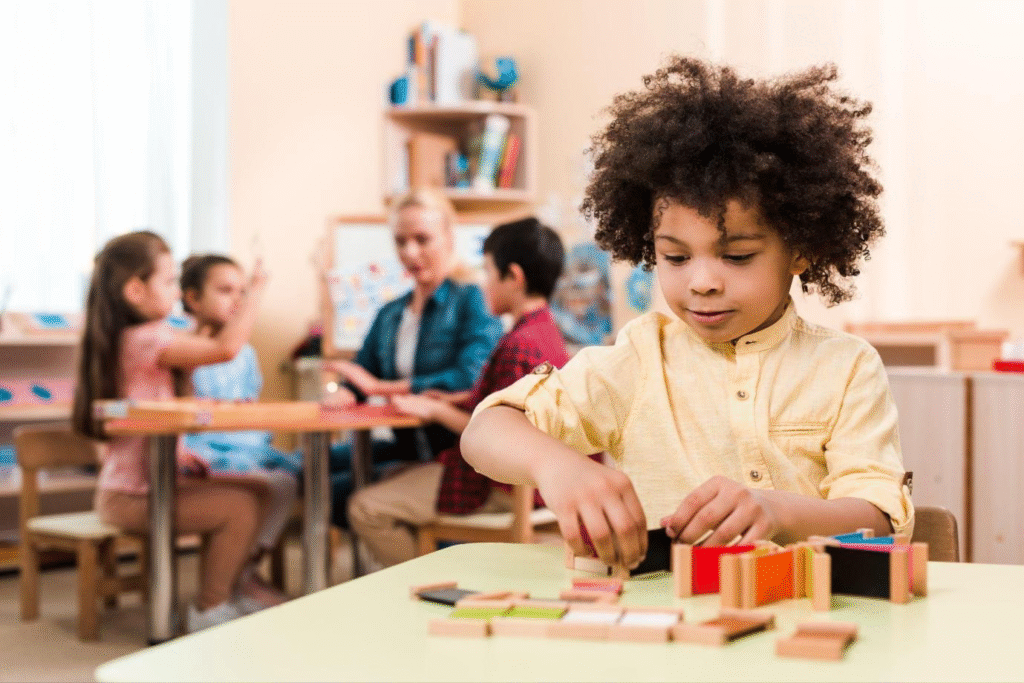
Rather than seeing every child doing the same activity, you’ll notice children working on different lessons based on their interests and readiness.
One child may be exploring early math materials.
Another may be practicing letter sounds.
Nearby, another child might be completing a Practical Life activity that helps develop concentration and coordination.
Although the children are doing different activities, every lesson is part of a carefully planned Montessori curriculum.
In many daycare settings, activities are designed for the whole group, with children moving together from playtime to crafts, storytime, and outdoor play.
Neither approach is right or wrong. They simply offer different learning experiences.
If you’d like to see what daily life in a Montessori classroom is like, read other articles for a closer look at our daily routines, learning activities, and Montessori environment.
Independence Is Part of Everyday Learning
Montessori encourages children to do as much as they can for themselves.
Throughout the day, children are given opportunities to practice everyday skills that build confidence and responsibility.
These might include:
- Returning learning materials to the shelf
- Cleaning up after an activity
- Caring for the classroom
- Preparing for the next lesson
These routines may seem simple, but over time they help children become more independent both at school and at home.
Parents visiting EverBright often tell us they’re surprised by how capable young children can be when they’re given the opportunity to do things on their own.
At EverBright Montessori Academy, our Montessori curriculum is designed to build practical life skills alongside early academic learning.
You can learn more about how we support children at different stages through our Preschool Program and Toddler Program.
Teachers Play a Different Role
Teachers are important in every early childhood program, but their role looks different in Montessori.
Rather than leading the entire class all day, Montessori teachers spend much of their time observing each child and introducing new lessons when the child is ready.
This allows children to learn at their own pace while still receiving individual support.
At EverBright Montessori Academy, our experienced Montessori teachers create a supportive environment where every child can learn and grow with confidence.
Mixed-Age Classrooms Encourage Learning Together
Another unique feature of Montessori is the mixed-age classroom.
Instead of separating children strictly by age, Montessori classrooms typically include children across a three-year age range.
This creates opportunities for younger children to learn by observing older classmates, while older children build confidence by becoming role models.
During campus tours at EverBright, many parents notice children naturally helping one another, creating a respectful and supportive classroom environment.
Which Option Is Better?
The answer depends on your family’s needs.
A daycare may be a good fit if you:
- Need flexible childcare hours.
- Are mainly looking for supervised care.
- Prefer a traditional daily schedule.
A Montessori preschool may be a good fit if you:
- Want your child to develop independence from an early age.
- Value hands-on learning instead of worksheets.
- Prefer an educational approach that follows your child’s individual pace.
- Want a consistent learning philosophy throughout the preschool years.
If you’re researching Montessori education and looking for more guidance, explore our articles, where we answer many of the most common questions parents ask, from choosing the right preschool to understanding the Montessori approach and preparing for your child’s first day.
Why Families Choose EverBright Montessori Academy
Many families from Chino, Chino Hills, and nearby communities visit EverBright because they want more than childcare.
They want an environment where their children feel confident, supported, and excited to learn.
During a school tour, you’ll often notice children concentrating on different activities, teachers quietly guiding individual lessons, and classrooms that feel calm and organized.
You’ll also discover enrichment programs that complement the Montessori curriculum, including:
These experiences help children grow academically, socially, emotionally, and physically in a supportive learning environment.
Final Thoughts
Both daycare and Montessori preschool provide valuable experiences for young children.
The difference is that Montessori is designed to help children become independent learners through a carefully prepared environment and hands-on experiences.
Every family has different priorities, and there’s no one-size-fits-all answer.
The best way to know if Montessori is the right fit is to experience it yourself.
We invite you to schedule a tour, meet our teachers, observe the classrooms, and see how children learn every day at EverBright Montessori Academy.