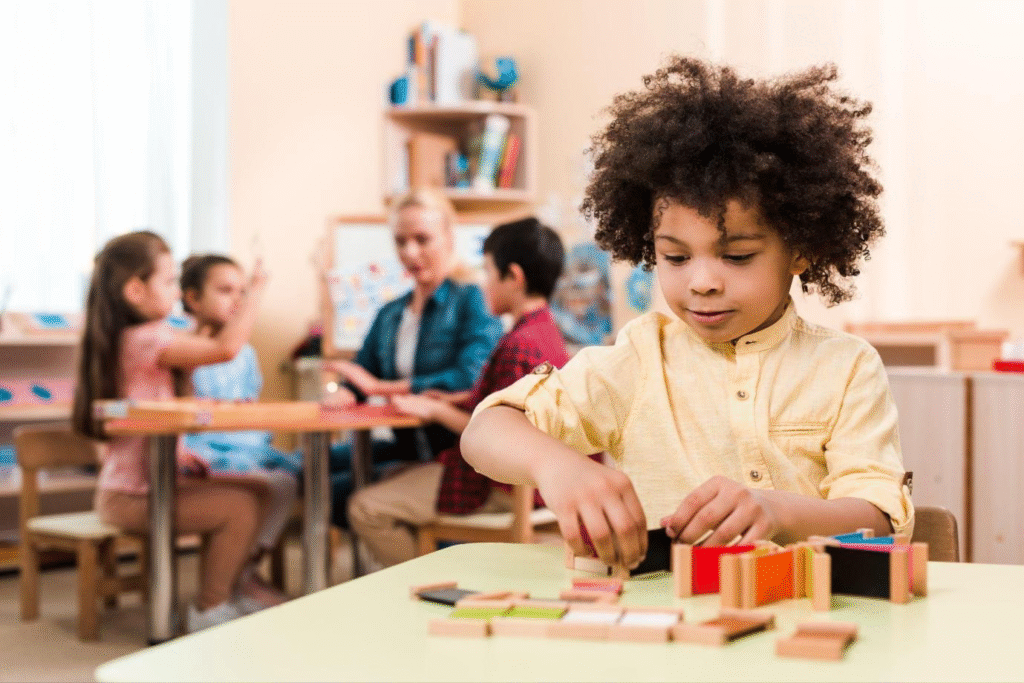
Walk into a Montessori classroom on a typical morning, and you probably won’t hear a teacher telling every child what to do next. Instead, you’ll see children carefully choosing activities, rolling out work mats, carrying trays, helping classmates, and concentrating on tasks that genuinely interest them.
For many parents, this calm atmosphere is one of the biggest surprises during their first school tour. Rather than following a rigid schedule where everyone does the same activity at the same time, children move through the day with a balance of structure and independence. Every part of the routine has a purpose, from hanging up a backpack independently to preparing a snack or caring for classroom materials.
While every classroom and every child is unique, the daily rhythm remains consistent. That predictable routine helps children feel secure while giving them the freedom to explore, learn, and grow at their own pace.
Here’s what a typical day in Montessori looks like at EverBright Montessori Academy.
A Calm Welcome Sets the Tone for the Day
The day begins quietly, without rushing children from one activity to the next.
As children arrive, teachers greet each child warmly by name, helping them transition comfortably from home to school. These simple interactions help children feel seen, respected, and ready to begin their day.
Rather than having adults do everything for them, children are encouraged to complete small tasks independently. They hang up their backpacks, put away their water bottles, change into indoor shoes if needed, and prepare themselves for the morning.
Some children eagerly begin working with classroom materials right away. Others spend a few moments observing the classroom before choosing an activity.
Both approaches are completely normal.
Our Montessori teachers gently guide children through this transition without pressure, recognizing that every child settles into the day differently.
The Morning Work Cycle Is the Heart of a Montessori Day
One of the biggest differences parents notice during a day in Montessori is the uninterrupted morning work cycle.
Instead of moving every child through the same lesson every 20 or 30 minutes, children have a long block of uninterrupted time to choose meaningful work from carefully prepared classroom shelves.
During a classroom visit, you might notice one child tracing sandpaper letters while another quietly pours water between two small pitchers. Across the room, another child may be building the Pink Tower, while two classmates work together on a puzzle. Every child is engaged in different work, yet the classroom feels calm rather than busy.
Some of the activities you may see include:
- Pouring water between two small pitchers
- Tracing letters using sandpaper letters
- Sorting objects by color, size, or shape
- Buttoning and unbuttoning dressing frames
- Counting with number rods and beads
- Carefully carrying classroom materials across the room
Although these may appear simple, each activity has been thoughtfully designed to strengthen concentration, coordination, problem-solving, and independence.
Teachers spend much of this time observing rather than directing every movement. When a child is ready for a new lesson or needs support, the teacher provides individual guidance at the right moment.
Perhaps the most noticeable difference is that children are not constantly interrupted. If a child is deeply focused, they are given the opportunity to finish naturally rather than being asked to stop because the schedule says it’s time for something else.
This uninterrupted work cycle is considered one of the core components of Montessori education.
According to the American Montessori Society (AMS), uninterrupted work periods allow children to develop concentration, independence, and self-motivation through meaningful activity.
Why Do Children Repeat the Same Activity?
Parents sometimes notice a child pouring water or arranging blocks several times in a row and wonder why the teacher doesn’t encourage something different.
In Montessori, repetition is intentional.
Children naturally repeat activities while mastering a new skill. Every repetition strengthens coordination, confidence, and concentration. Rather than seeing repetition as boredom, Montessori recognizes it as an important part of learning.
Once a child feels confident, they naturally move on to a new challenge without needing external rewards or pressure.
Circle Time Brings the Classroom Together
Although Montessori encourages independent learning, children also spend time learning together as a community.
Later in the morning, the class gathers for circle time.
This is an opportunity to practice listening, taking turns, and participating respectfully in group discussions. Teachers may introduce a seasonal theme, read a story, explore a science topic, practice songs, or discuss kindness and friendship.
Rather than becoming the focus of the day, circle time often introduces ideas that children can continue exploring independently during their work cycle.
This balance between individual exploration and shared learning helps children build both confidence and strong social skills.
Snack Time Builds Independence
Snack time is another opportunity for children to practice everyday life skills.
Instead of simply being served food, children are encouraged to participate in the process. Depending on the classroom, they may prepare their eating space, pour their own drinks, use child-sized utensils, and clean up independently when they finish.
These routines are part of what Montessori refers to as Practical Life activities.
According to the American Montessori Society, Practical Life experiences help children develop concentration, coordination, independence, and a sense of responsibility while preparing them for increasingly complex learning.
Families who would like to learn more about meals at EverBright can also explore our School Lunch Program.
Outdoor Play Is Part of Learning
After a morning of focused classroom work, children head outdoors to move, explore, and play.
Outdoor play is much more than a break between lessons.
Running, climbing, balancing, throwing, and imaginative games all contribute to healthy physical development while helping children strengthen coordination, confidence, and social skills.
Montessori education recognizes that movement and learning are closely connected. Children learn not only through listening and observing but also by interacting with their environment using their whole bodies.
At EverBright Montessori Academy, outdoor play is complemented by our Physical Education Program, where children continue developing balance, coordination, strength, and teamwork through age-appropriate activities.
Enrichment Activities Add New Experiences
Throughout the week, children also participate in enrichment programs that complement their Montessori learning.
These may include:
- STEAM activities that encourage creativity and problem-solving
- Language lessons introducing new vocabulary through songs and conversation
- Art and music experiences that inspire creativity and self-expression
Rather than feeling like separate classes, these activities are thoughtfully integrated into the school day, giving children opportunities to explore new interests while maintaining the calm rhythm of the Montessori environment.
Lunch and a Well-Deserved Rest
Lunch continues the same philosophy of independence that children practice throughout the day.
Children use real utensils, help care for their eating space, and practice respectful table manners while enjoying a meal with classmates. Teachers model healthy habits and encourage children to become increasingly confident in managing everyday routines.
After lunch time at EverBright, our younger children have time to rest and recharge. Older preschoolers who no longer nap may spend this period reading quietly, working independently, or participating in calm classroom activities before the afternoon begins.
This natural transition helps children regain energy while keeping the overall rhythm of the day peaceful and consistent.
The Afternoon Brings New Opportunities to Learn
As the afternoon begins, children return to the classroom for another work period. While the morning is often filled with deep individual concentration, the afternoon sometimes has a slightly different rhythm.
You may notice children working together on a puzzle, taking turns during a language activity, or helping a younger classmate complete a task. Others may continue exploring materials they started earlier in the day, building on what they’ve already learned.
This is also when teachers often introduce extension lessons to children who are ready for a new challenge. Because Montessori teachers spend much of the day observing each child’s progress, new lessons are presented when the child is developmentally ready, not simply because the schedule says it’s time to move on.
The mixed-age Montessori classroom naturally encourages collaboration. Younger children learn by watching older classmates, while older children strengthen their own understanding by helping others. These everyday interactions develop patience, leadership, empathy, and confidence alongside academic skills.
If you’d like to learn more about the programs that support your child’s growth, explore our Preschool Program and Toddler Program.
Preparing to Go Home
As the school day comes to a close, children begin putting away their work, tidying the classroom, and collecting their belongings.
These small responsibilities are an important part of Montessori education. Caring for the classroom teaches children that they are active members of their community, not simply visitors using someone else’s space.
When parents arrive, one of the first questions they often ask is:
“Did you have fun today?”
The answer is usually something like:
“Yes.”
Or simply:
“I don’t know.”
Instead, try asking questions that encourage your child to reflect on their experiences:
- What was your favorite activity today?
- What new thing did you learn?
- Who did you work with today?
- Did you help someone today?
- What made you smile today?
These open-ended questions often lead to richer conversations and help children develop their communication and storytelling skills.
To help families stay connected, EverBright Montessori Academy uses its Family Communication App, where parents receive classroom updates, photos, and daily information, giving families a meaningful glimpse into their child’s learning journey.
Every Montessori Day Is Familiar, Yet Never Exactly the Same
Although the daily rhythm remains consistent, no two days in Montessori are ever identical.
One child may spend extra time mastering a new math material, while another discovers a love for language activities. A spontaneous discussion about insects might inspire outdoor observation, or two children might develop a new friendship while working together on a classroom project.
This balance of routine and discovery is one of Montessori’s greatest strengths.
Children know what to expect each day, which helps them feel secure, yet they always have opportunities to explore new ideas, develop new skills, and follow their own curiosity.
That combination creates an environment where learning feels meaningful rather than forced.
See a Montessori Day for Yourself
Reading about Montessori can give you a good understanding of how the approach works, but seeing children confidently learning in the classroom brings it to life in a completely different way.
When you visit EverBright Montessori Academy, you’ll have the opportunity to observe children engaged in meaningful work, meet our experienced Montessori teachers, and see how independence, concentration, and joyful learning naturally come together throughout the day.
The best way to understand Montessori, however, is to experience it in person. We’d love to welcome you to campus and show you what a typical school day looks like. You can schedule a personal tour at a time that’s convenient for your family